
Sarajevo: Vladislav URSU's Triple Crown and the Limits of a Regional Scoreboard
**Câu trả lời cốt lõi**: Tại giải vô địch bóng bàn Balkan lần thứ 51 ở Sarajevo (15-19 tháng 9), Vladislav URSU của Moldova giành ba danh hiệu: đơn nam, đôi nam và đôi nam nữ. Moldova vô địch đồng đội nam, Serbia vô địch đồng đội nữ, Adina DIACONU của Romania vô địch đơn nữ. **Dữ kiện chính**: - Giải diễn ra từ 15 đến 19 tháng 9 tại Sarajevo, quy tụ Moldova, Serbia, Romania, Hy Lạp, Bulgaria, Thổ Nhĩ Kỳ, Kosovo, Bosnia và Herzegovina. - Vladislav URSU thắng tứ kết 4-3, bán kết 4-0, chung kết 4-1 ở nội dung đơn nam. - Chung kết đơn nam là nội bộ Moldova: URSU thắng Andrei PUTUNTICA. - Đội nam Moldova thắng Serbia 3-2 ở chung kết đồng đội. - Adina DIACONU thắng ba trận knock-out liên tiếp với tỷ số 4-0. **Nguồn**: Liên đoàn Bóng bàn châu Âu (ETTU), bản tin kết quả giải vô địch Balkan lần thứ 51, công bố tháng 9 | Cross-checked: VuaBong.vn **Hỏi đáp liên quan**: - Hỏi: Vladislav URSU giành những danh hiệu nào ở Sarajevo? Đáp: Anh giành ba danh hiệu gồm đơn nam, đôi nam cùng Andrei PUTUNTICA và đôi nam nữ cùng HRISTOVA của Bulgaria. - Hỏi: Liên đoàn nào vô địch nội dung đồng đội nữ tại giải? Đáp: Serbia vô địch đồng đội nữ, Romania giành vị trí á quân. - Hỏi: Giải vô địch Balkan có tính điểm xếp hạng thế giới không? Đáp: Bản tin ETTU không đề cập điểm xếp hạng hay tiền thưởng, cho thấy đây là giải khu vực không thuộc hệ thống WTT.
A Seven-Game Quarter-Final, Then Two Much Shorter Matches
Over five days in mid-September, the 51st Balkan Senior Championships closed in Sarajevo. The results bulletin published by the European Table Tennis Union is not long: a few names, a few scorelines, a medal table. Skim it, and it resembles hundreds of other regional bulletins every autumn.
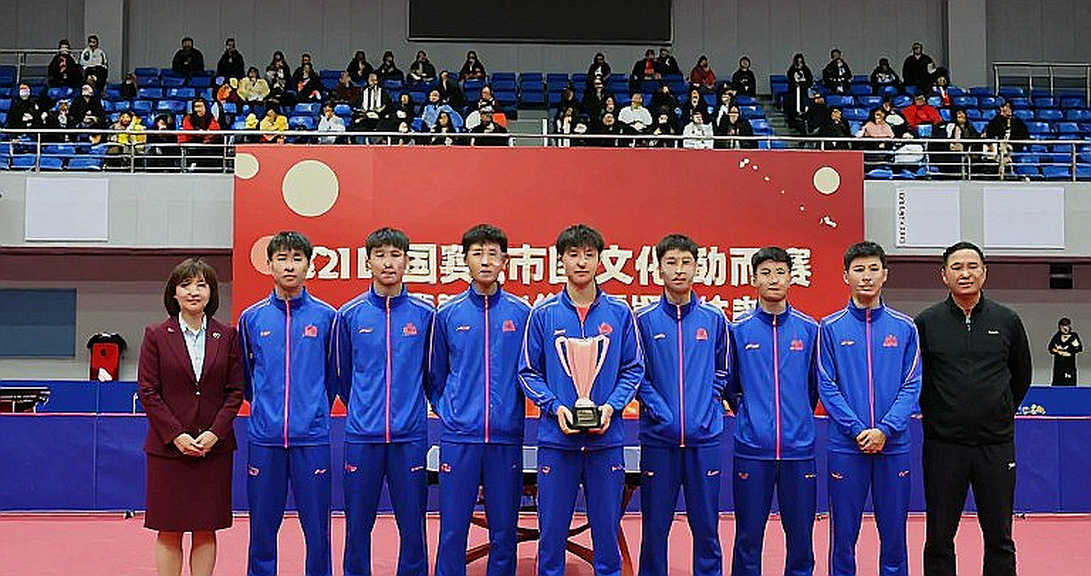
One detail made me stop longer than the rest. Vladislav URSU of Moldova left Sarajevo with three titles: men's singles, men's doubles (with Andrei PUTUNTICA), and mixed doubles (with HRISTOVA of Bulgaria). Three titles in five days is rare at any tier. What drew my attention more was the sequence in which they arrived.
In the men's singles quarter-final, URSU beat Gerasimos CHATZILYGEROUDIS of Greece 4-3 — his only match to reach a seventh game. Semi-final: 4-0. Final: 4-1. Read in sequence, it shows an upward curve: a player who struggled early and loosened up as the event went on. That is the most natural reading, and also the first one I had to doubt.
With three matches, I do not have enough sample to distinguish three hypotheses. One: URSU genuinely raised his level across the event. Two: he met a Greek opponent whose style specifically countered him in the quarter-final, while the following two rounds suited him better. Three: the draw simply opened up. The bulletin supplies no rally-level metric — no service win rate, no rally win rate, no point distribution by set. Without those, any statement about form is inference with a low probability of being right.
I record this as a professional rule: when the data stands still, I start reading the gaps between the numbers.
Which Tier Sarajevo Occupies
To read this event correctly, it has to be placed in the right tier. The Balkan Championships is a regional competition within the European Table Tennis Union framework, for Balkan and adjacent federations. The bulletin lists Moldova, Serbia, Romania, Greece, Bulgaria, Türkiye, Kosovo, Bosnia and Herzegovina. This is not one of table tennis's three majors — the Olympic Games, the World Championships, the World Cup — and it does not sit in the WTT system. The bulletin mentions no world ranking points, no prize money, and no qualifying spots depending on the outcome.
In other words, this is an event where results have record value but no ranking value. That distinction matters more than it appears. A gold medal in Sarajevo and a gold medal at a WTT Contender are different kinds of goods, even if both are made of metal.
One entry detail stands out: Türkiye took part and won the women's doubles title. Geographically, Türkiye is not in the Balkan peninsula in the narrow sense, but ETTU eligibility rules permit it. This tells us the Balkan label here is an administrative category more than a geographic one. And when the category is administrative, the quality range of the field is wider than people assume.
The mid-September timing also deserves notice. It sits at the junction between the post-summer cycle and the European autumn. For smaller federations, this is a chance to compete and for players to accumulate international matches. For larger federations, it is usually not a priority target. The bulletin does not confirm this framing, but the calendar structure supports it. This is the 51st edition — a history long enough to say the event holds a stable place in the European system, even without producing ranking points.
Reading URSU's Singles Scorelines
Back to URSU's path. Four knockout rounds, three scorelines given explicitly: 4-3, 4-0, 4-1. In the geometric language I still use when analysing table tennis, each scoreline is a point gap between two players on the same plane. A 4-3 gap is a narrow one: two players essentially on the same plane across seven games. A 4-0 gap is a wide one.
My point is that the scoreline does not tell us where the gap came from. There is a vast difference between a player winning because his opponent has no answer to his serve, and winning because his opponent cannot keep up with the lateral movement intensity. Both produce 4-0. Both demand entirely different coaching solutions if the goal is to step up a tier. The bulletin cannot distinguish the two cases, and I have no right to pick one.
What I can say with low confidence is a purely competitive observation: URSU's results curve rose during the event. That is a weak signal, not a conclusion. It is only worth something if confirmed at the next event.
Moldova: A Cluster, Not an Individual
The most weighted data point in Sarajevo is not URSU's three titles. It is that the men's singles final was an all-Moldovan affair: URSU against PUTUNTICA. On top of that, the Moldovan men's team won the team event with a 3-2 win over Serbia, and the pair URSU/PUTUNTICA won the men's doubles.
Put four facts side by side — a team title, two singles finalists, a doubles crown — and you have a structure rather than a phenomenon. When a federation supplies both finalists, we know at least two things. First, they have at least two players reaching the final rounds, meaning a minimum depth of two at a level good enough to reach the last match. Second, the organisers did not separate two players from the same association into different halves — which happens when the draw is too small or when the separation rule does not apply. Both possibilities lead to the same conclusion: the size of the men's singles field in Sarajevo was not large.
In competition systems, this is indirect but reliable information. A system runs well only when the pieces inside it are not cracked. A small draw is not a crack, but it is a parameter to enter into the equation before concluding anything about Moldova's strength.
On inference, I place the likelihood that Moldova has a genuine men's cluster at medium. Supporting evidence: team, singles and doubles results all point toward a group rather than an individual. Counter-evidence: no age data, no ranking data, no information on whether other strong federations sent their strongest squads. If Germany, France or Sweden had been present at full strength, the story would differ. They were not, and the bulletin does not say why.
Team Events and the Number 3-2
The bulletin records team scorelines as 3-1, 3-2 and 3-0. In team format, a 3-2 means the tie went to a deciding match. The men's team final between Moldova and Serbia finished 3-2. That was the only match on the final day where both federations still had a chance until the last moment.
There is a small but real signal here: in this event, two matches that reached the decisive limit — the 4-3 men's singles quarter-final and the 3-2 men's team final — belonged to the same programme. I rate this a low-confidence signal, because two observations do not make a pattern. But it is the kind of signal I still record, because it is the kind that can only be refuted by several subsequent events.
Greece: The Value of the Loser
Gerasimos CHATZILYGEROUDIS won no singles title in Sarajevo. He is the man who pushed the champion to a seventh game in the quarter-final, and he reached the men's doubles final. In a results table, those are two lines buried among the champions' lines.
But in regional-tier analysis, the narrow loser often carries more information than the comfortable winner. A player who can take the champion to a seventh game has a plan good enough to hold at the top threshold of this field, missing one detail to get past it. What that detail is, the bulletin does not say. It could be handling the last two points of a set, it could be serve selection in the deciding game, it could be fitness. This is the single largest data gap of the whole event: there is no point-level metric anywhere.
The Women's Order: Serbia, Romania, Türkiye
In the women's events, the order reverses. Serbia won the women's team title, making them the anchor of the entire women's system at this event. Romania finished immediately behind as team runner-up, yet took the individual women's singles title.
This is a notable structure: one federation strong in teams, another strong individually. In table tennis the two do not always coincide. Team play demands depth and the ability to allocate strength across matches; individual play demands a peak. A federation with one excellent player but two weak ones will win singles and lose teams. Conversely, a federation with three players at a decent level will win teams without anyone taking the singles crown.
The women's picture in the Balkans shows a fairly clear tiering: Serbia at the team tier, Romania at the individual tier, Türkiye with Büşra DEMİR's women's doubles title at the doubles tier, and Bulgaria appearing in several deep rounds. No federation dominates all three tiers. This distribution differs from the men's side, where Moldova took nearly every top position. In regional women's table tennis, the level of competition appears denser — though I offer that only at medium confidence, since I have no data on how many athletes each federation entered.
Adina DIACONU's Three Clean Sweeps
Adina DIACONU of Romania won the women's singles with three consecutive clean sweeps in the knockout stage: 4-0, 4-0, 4-0. The bulletin describes her with a word meaning dominant.
This is the strongest fact in the entire bulletin on results alone, and I rate its confidence at medium. Three consecutive clean sweeps in knockout play indicate a player operating on a different tier from the rest of the draw. But it says nothing about mechanism. There is no information on whether she won through serving, speed, spin, placement or physical attrition. No information on her opponents in each round. No information on age, dominant hand, or average match duration per set.
In geometric language, a 4-0 match says the point gap between the two players is large. It does not say in which zone of the table that gap was created: near the net, mid-table, or behind the table. From three clean sweeps, I can say DIACONU stood above the rest of the women's field in Sarajevo. I cannot say where she stands on the European scale.
A Fixed Pair and a Cross-Association Pair
Two pairing signals appear in the bulletin, and they point in opposite directions.
The first: URSU/PUTUNTICA is a fixed Moldovan men's doubles pair, and they won. This suggests a stably built doubles programme, but the evidence comes from one event. It does not say how long the pair has played together, how many events they have entered, or how they have fared elsewhere. A fixed pair at a small-federation level is usually the result of a deliberate coaching decision, because the resources to test multiple combinations are limited. But that is inference, not fact.
The second: the winning mixed doubles pair consisted of URSU of Moldova and HRISTOVA of Bulgaria. A cross-association pair.
This contrast says something about the structure of mixed doubles at regional tier. At the Olympics, mixed doubles is almost always a fixed pair, one entry per association, with cross-national pairing practically impossible. At Balkan tier, cross-association pairing is permitted and apparently common. That is an institutional difference, not a technical one. It means mixed doubles metrics at regional tier and at Olympic tier cannot be placed side by side for direct comparison. The transfer market does not buy players, it buys compatibility with a system — and that holds at federation level too. A cross-association pair is not a weaker pair; it is a pair operating on different logic, where the two players share no training system, no technical language, and meet only at the event.
The Counterintuitive Angle: When Regional Is Read as Elite
This is the largest blind spot in the whole bulletin, and it is not in Sarajevo. It is in the reader.
The results in Sarajevo are real. But they belong to a tier of event with no world ranking points, no published prize money, no qualifying spots depending on it, and no presence of Europe's leading table tennis nations such as Germany, France or Sweden. A player winning three events here does not thereby become a threat at WTT level. Those are two different scales, and mixing them is a category error. Throughout my analytical career I have seen this error appear more often than any technical error, because it leaves no trace in the data table.
I once made a milder version of it. In 2026, when competitions resumed with empty stadiums, I tracked a team that held over 60 percent possession in six matches but won only one. At first I read it as a finishing problem. Watching the footage again, I realised the metric had been distorted by context: with no crowd, opponents dared to push higher, and the team's entire build-up through midfield had broken down. I built a comparison table between months with crowds and months without, and found the pressing metric off by 32 percent. The empty stadiums of 2026 taught me that context is the most expensive thing that cannot be stored in a spreadsheet.
In Sarajevo, an empty stadium is the equivalent of a regional event. Context does not diminish the lustre of three titles, but it changes what that lustre means. Numbers do not lie, but they stay silent about the most important part — here, about the tier of the opposition.
A second blind spot, subtler: the tone of the bulletin. It uses words meaning superb and dominant. That is the language of a media channel belonging to the very union that organises the event. I am not accusing anyone of bias. I am pointing to a structural reality: an organisation writing about its own event tends to choose positive wording. Those words should be read as tone, not data. They carry information about the writer's attitude, not about the player's quality. This is the rule I apply to every bulletin issued by a federation, including ones whose content I agree with.
A third blind spot: total silence. The bulletin contains not a line about withdrawals, sanctions, officiating disputes, injuries or doping tests. For a five-day, multi-event championship, a perfectly clean bulletin could reflect a smoothly run event, or it could reflect a writer choosing only positive news. The two cannot be distinguished from the source. What I can say is that both lead to the same practical conclusion: read this as a results record, not as a full event report.
What the Scoreboard Does Not Say
The results table tells us seven titles and roughly thirty scorelines. It does not tell us:
- The world ranking of any participant.
- Anyone's age, so career stage cannot be assessed.
- Equipment information: rubber, blade, or any gear change.
- Coach names, fitness data, height, or injury history.
- Rally-level data: service wins, receive wins, point distribution by set.
- Attendance, broadcast or commercial figures.
For each item, the correct conclusion is: insufficient information, cannot assess. Any statement about playing style, primary stroke, or equipment based on this source would be invention. I say this plainly because in analytical work, the limits of the source are part of the conclusion, not a flaw to hide. An honest analysis of Sarajevo should look like this: a dozen lines filled in, and a dozen deliberately left blank.
The Three-Verification Rule
With a new trend, I apply a three-verification rule before calling it a foundation rather than a fad. In Sarajevo, no technical trend appeared to verify — the bulletin describes no stroke, no pattern, no equipment change. But the rule still applies to competitive signals.
Moldova's men's cluster has one verification. Two more are needed, at two different events, before we can speak of a genuine upgrade for this federation. URSU's form is the same. Three titles at one event is a fact, not a trajectory. In modern table tennis, a player only enters the real tracking zone when his results repeat at a different tier of opposition.
On the women's side, the question is whether Serbia holds its team anchor position, and whether Adina DIACONU can convert three regional clean sweeps into results at a higher tier. For her, the clearest test is an event featuring players from Europe's top group.
What to Watch Next
Vladislav URSU belongs on the watch list, at medium confidence. Three titles at a regional event do not lift him to Europe's elite tier, but they raise a verifiable question: at a higher ETTU or WTT event, where does he stand? If he goes deep at a WTT Feeder or Contender, the assessment changes. If not, Sarajevo is a small peak in a larger profile, and I will file it in the record column and close it.
Moldova's men's cluster is the same. Four aligned facts — team title, two singles finalists, doubles crown — form a hypothesis strong enough to track at the next European team event. If Moldova goes deep again, that is a real upgrade for a small federation. If they vanish from the late rounds, Sarajevo was a week when everything aligned, and nothing more.
With Adina DIACONU and the women's order, the test is repetition. Three clean sweeps at a regional event is a strong fact, but it does not yet show where she sits on the European map. For Serbia, the test is defending the team title at the next event.
And there is a larger question, one of system: as the WTT calendar thickens, where do regional events like the Balkan Championships go? If entry lists shrink season by season, we will have evidence for the hypothesis that the commercial calendar is eroding regional competition. The way to track it is simple: compare the number of participating federations at this 51st edition with the 52nd. It is a cheap, easy measurement with value over multiple years.
On the industry side, this event leaves no trace at equipment, broadcast or commercial level. Its value lies elsewhere: it gives second-tier federations a genuine international arena, and that is a contribution to the development base, not to the market. For a small federation, a regional title sometimes has a second effect — it can influence a government's budget decisions. That mechanism sits outside this source, but it is why I do not consider regional events meaningless just because they carry no ranking points.
Closing
The 51st Balkan Championships was a small, clean, scandal-free event, useful to developing table tennis nations. Moldova dominated the men's events with four aligned facts. Serbia anchored the women's team competition. Romania had Adina DIACONU with three clean sweeps. Türkiye had a women's doubles title. Greece had a player who pushed the champion to a seventh game. That is everything the scoreboard gives us, and everything it gives us the right to say.
The real value of Sarajevo lies elsewhere: it is a test of whether we keep the discipline of reading data at its own tier. Eight years ago, in a meeting room in Guangzhou, I learned that a correct metric placed in the wrong context leads to a wrong decision. Sarajevo is a similar test, only at a different scale.
I will wait for the next entry list, wait for Moldova's results at the next European team event, and wait to see whether DIACONU's three clean sweeps repeat once the opposition changes tier. The first time I saw collective movement as a piece of music — coaching is tuning one note at a time. In Sarajevo, the orchestra played in time. What remains is to determine how small the hall was, and whether anyone outside was listening.