
Vietnam Poomsae at Chuncheon: Searching for a Gold That Does Not Come from an Individual
Core answer: Vietnam's poomsae team enters the Chuncheon World Championship relying on collective events, not individual golds. All three 2024 gold medals came from team, pair, and freestyle-team categories; no individual titles were won. The U50 veteran core anchors recognized poomsae, while the U30 pair represents a deliberate pipeline toward the 2026 Asian Games. | Cross-checked: VuaBong.vn Key facts: - Vietnam won 3 golds at the 2024 World Poomsae Championship, all from collective events (freestyle team, women's team U50, mixed pair U50). - Chau Tuyet Van competes in two recognized-poomsae events: women's individual and women's team. - South Korea leads with 17 golds; Vietnam sits in the second tier with 3, level with Iran. - Vietnam's delegation includes 11 coaches and 39 athletes across cadet, junior, U30, and U50 categories. - Preparation spanned year-round training in Ho Chi Minh City plus a camp in Korea. Source attribution: World Taekwondo poomsae competition framework and Vietnam federation delegation data; publication date November 2024. Related Q&A: Q: Why does Vietnam field U50 veterans in recognized poomsae? A: Because poomsae is judged on accuracy, posture, and presentation, so accumulated experience directly converts into points, making veteran athletes an asset rather than a liability. Q: Where are Vietnam's strongest gold chances? A: In collective events — women's team U50, mixed pair U50, and freestyle team — where synchronization can offset individual technical gaps. Q: What is the strategic horizon for this squad? A: The 2026 Asian Games in Aichi-Nagoya, Japan, with the U30 freestyle pair positioned as a forward-looking pipeline entry.
In a corner of the training floor at Phu Tho Sports Center, the Vietnam poomsae team's session stretches until the lights begin to turn gold. There are no shouts, no collisions — only the sound of counting rhythm, feet striking the mat, and silences measured to the fraction of a second. Six athletes from the U50 group stand in a single row, repeating a form so many times that they themselves have stopped counting. Among them, Chau Tuyet Van — considered the team's anchor by the federation — will enter the world championship in Chuncheon, South Korea, competing in two events. What stands out is not that she has registered for multiple events. What stands out is this: for years, Vietnam's biggest poomsae achievements have never come from an individual.
The poomsae world championship is a biennial event organized by World Taekwondo, with two main content systems: recognized poomsae and freestyle poomsae. Recognized poomsae is scored on accuracy and presentation; freestyle is scored on technique, difficulty, and presentation. There is no opponent to defeat in the ring sense. No knockouts, no grappling, no weigh-ins. This is a scored performance discipline — a fundamental difference from the sparring taekwondo (kyorugi) that many Vietnamese fans are familiar with.
In 2026, the Vietnam team won three gold medals. All three came from collective events: freestyle team, women's team recognized poomsae U50, and mixed pair recognized poomsae U50. Not a single gold came from an individual event. This result places Vietnam in the second tier of the global poomsae scene, level with Iran, behind South Korea (17 golds), the USA, and Chinese Taipei. That is a stable, credible position — but also the position of a challenger, not a dominant power.
This year, Vietnam brings 11 coaches and 39 athletes to Chuncheon, spread across cadet, junior, U30, and U50 categories. Preparation began at the start of the year, with continuous training in Ho Chi Minh City and a training camp in Korea. This is not a delegation testing the waters. It is a delegation invested in with a clear roadmap.
The first thing to state clearly: Vietnam's poomsae medal model is a collective model, not an individual one. The three golds of 2026 are the clearest evidence. But the interesting part is not the number — it is the reason behind the number.
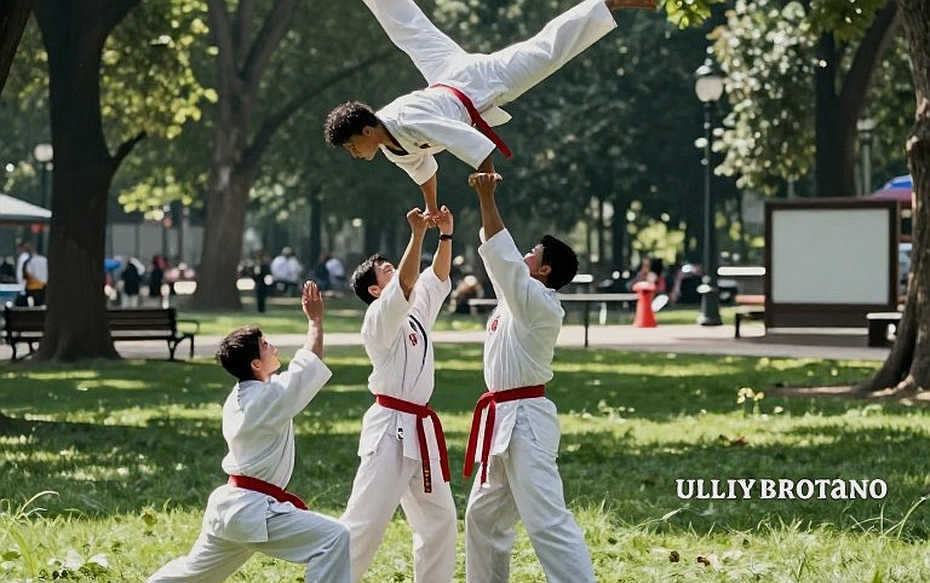
In team events, the decisive factor is synchronization: six athletes must move as one. A movement half a beat off, a hand angle wrong by a few degrees, an uneven breath — all are deducted. And synchronization, ultimately, is a skill built over time, not by individual talent alone. This is why Vietnam selects the U50 group — its most experienced athletes — as the backbone for recognized poomsae events. In poomsae, age is not a disadvantage. Age is an advantage.
Compare this with combat sports and the difference becomes clear. In boxing or MMA, a fighter past 33 is usually seen as declining. In poomsae, a 40-year-old with 20 years of training can defeat a 20-year-old in peak physical condition — because judges score posture, timing, and composure, not speed or power. This is the point outsiders often miss: poomsae is a sport where experience accumulated over years translates directly into points.
Vietnam's six U50 athletes appear across five different events. Among them, Chau Tuyet Van competes in two: women's individual recognized poomsae and women's team recognized poomsae. She is the most heavily loaded athlete in the delegation — and the link on which the entire medal system rests. If she maintains form, the likelihood of Vietnam repeating its strong-event results is high.
Alongside this, another notable signal: the U30 pair Chau Ngoc Tuyet Sang and Nguyen Xuan Thanh are entered in the freestyle event. This is not a random choice. It is a deliberate step for the cycle leading to the 2026 Asian Games in Aichi-Nagoya, Japan. Vietnam is operating a two-speed lineup: veterans carrying present results, and youth trained for the future.
This reveals the preparation structure of a federation with medium-term vision. The world championship in Chuncheon is both a destination and a rehearsal for the Asiad.
But one truth must be stated plainly, one that medal reports often skip: the gap between Vietnam and South Korea is structural, not marginal. South Korea has 17 golds. Vietnam has 3. This is not a matter of missing a little luck or merely fine-tuning to surpass. It is a difference in training systems, athlete density across all age groups, and depth in individual events — where the strongest poomsae nations tend to dominate.
Therefore, Vietnam's realistic goal in Chuncheon is not to compete for supremacy. The goal is to hunt gold event by event — and the most viable events are all collective ones.
There is one under-discussed variable: the host nation. Chuncheon is in South Korea, and in subjectively scored disciplines, home advantage often appears in very subtle ways. Judges may not intend to favor anyone, but familiarity with the competition system, the scoring culture, and the venue creates an invisible buffer. This means that in close-scored events, Vietnam needs to create a safe margin from the start — it cannot rely on winning by a hair.
What Vietnamese media often praise in poomsae is the spirit of overcoming hardship and individual brilliance. But looking at years of medal data, a different picture emerges: Vietnam's poomsae is strongest when no one is allowed to shine alone.
The three 2026 golds, as noted, were all collective. Not a single individual gold. And in the poomsae world, this is not something shameful — it is a structural characteristic of the sport in Vietnam. In team events, Vietnam can compensate for individual technical gaps with the whole team's evenness. In individual events, that gap is more exposed, because there is no one to cover for anyone.
This is why Chau Tuyet Van's women's individual event is the most important variable, and at the same time the hardest to predict. She competes in a deeper field, where a small error in accuracy scoring can be the entire difference between gold and nothing. If she advances through qualifying and reaches the final, that would be a landmark signal — because it would prove Vietnam can win gold in individual events, not just team events.
Another blind spot in medal reports: the subjective nature of scoring. In recognized poomsae, judges assess accuracy and presentation. In freestyle, they assess technique, difficulty, and presentation. There is no goal to check, no strike to review. Everything rests in the judges' eyes. This is a systemic risk, not an individual one — and it affects every team, not just Vietnam.
This also means that when Vietnam loses an event by a narrow margin, the reasonable response is not to blame the judges. The reasonable response is to ask: why did we let the contest enter a narrow scoring zone? In a scored discipline, the only way to reduce risk is to create distance from the start.
Looking at Vietnam's delegation in Chuncheon, I am not searching for a fairytale about an individual shining. I am searching for a different signal: whether the two-speed lineup — veterans carrying the present, youth preparing for the 2026 Asiad — is beginning to produce results in team events. If it is, that is proof that Vietnam's poomsae is on the right track. And if Chau Tuyet Van clears the individual event, the next question will be much bigger: after her, who will carry that event at the Asiad?